

One morning, customer service takes a call: a customer reports that a product looks wrong. The first question from management is not "who made the mistake" but "Where is that lot now, and who has received it?"
For many manufacturers and distributors, answering that question takes hours, sometimes days. Not because the data is missing, but because it is scattered across too many places.
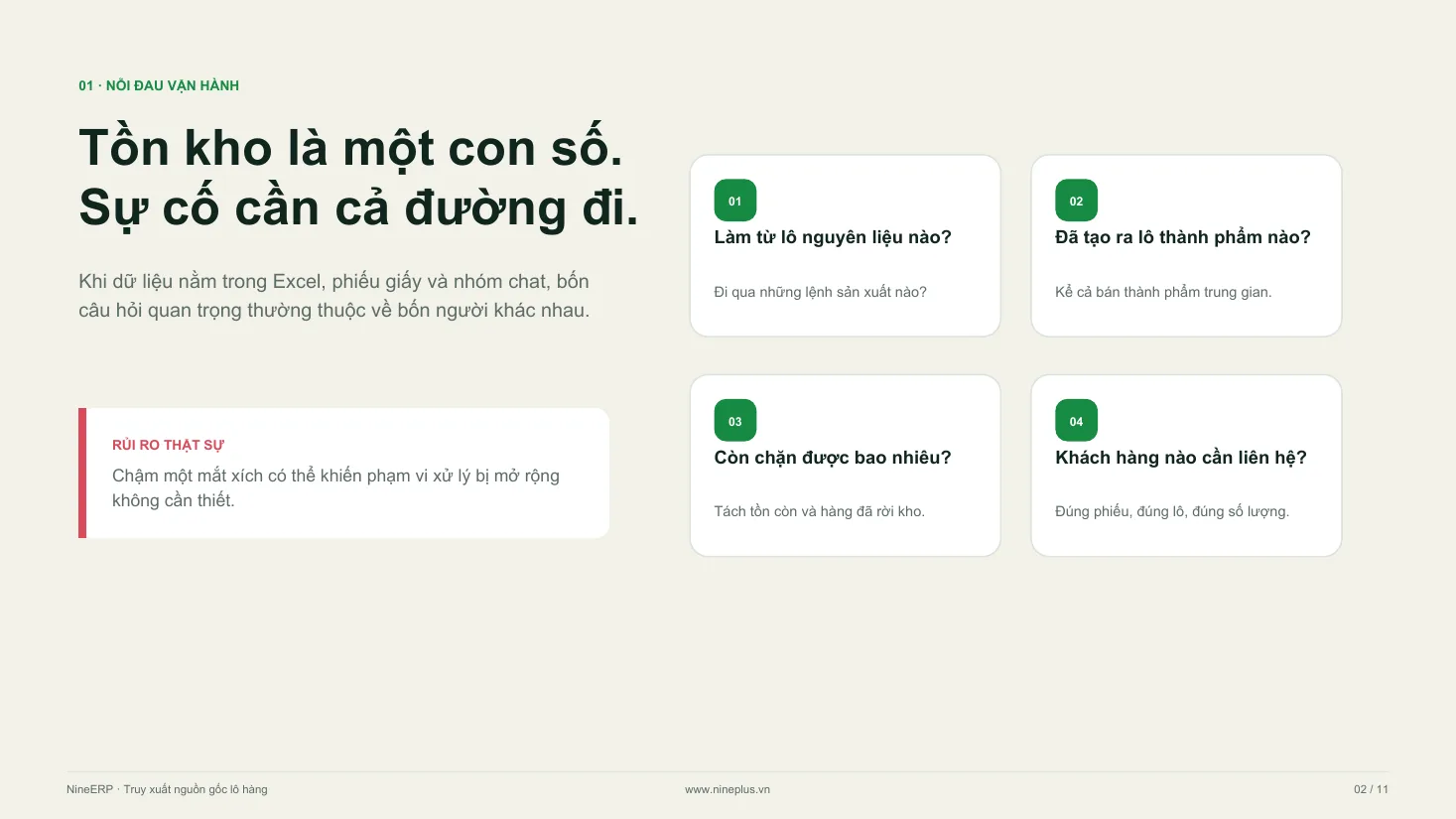
Four questions you must answer the moment a lot has a problem
- Which raw material lots was this finished lot made from?
- Which production orders and intermediate goods did it pass through?
- How much is still in stock, in which warehouse and which location?
- Which customers has it been shipped to, and how much each?
Answer slowly and you are left with two bad options: a broad recall "just to be safe" (costly, damaging to reputation), or a scope based on guesswork (the risk of missing something).
Why Excel, paper slips and chat groups are not enough
Excel is great for recording. But traceability is a chaining problem: linking material receipts to production orders, production orders to finished lots, and finished lots to delivery notes and customers.
In practice:
- Warehouse keeps the stock in/out file.
- Production keeps production orders, bills of materials and consumption.
- Sales keeps orders and delivery notes.
- QA keeps quality inspection records.
Each file is correct within its own scope, but no file sees the whole path of a lot. To trace, people open file after file, search code after code and call person after person. One wrong lot code or one missing date and the chain breaks.
A stock figure tells you how much is left. When a quality incident happens, you need the entire path.
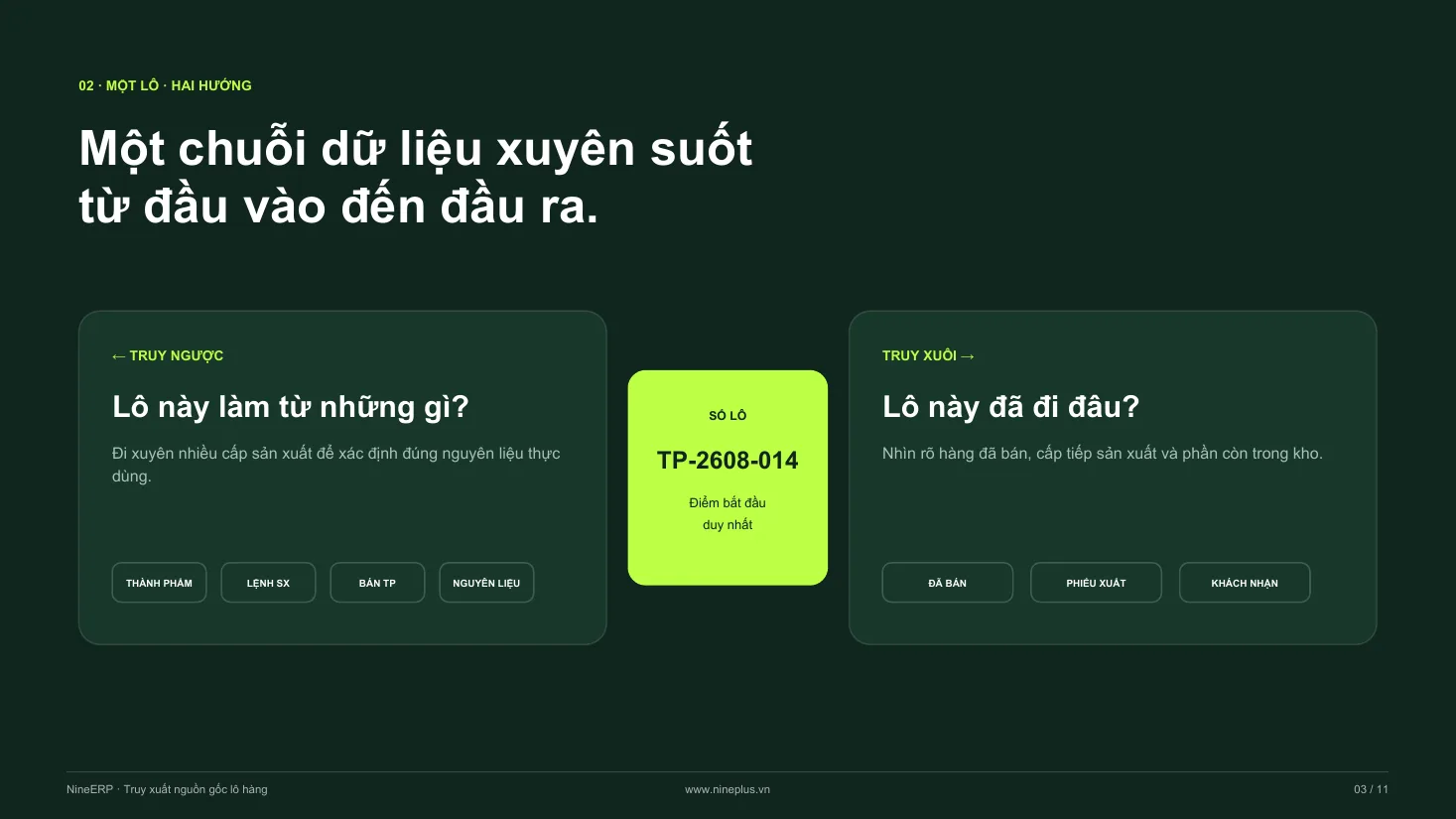
Two-way traceability: backward and forward
A real traceability system has to work in both directions:
Backward traceability — from finished goods back to the source:
Finished goods → Production order → Intermediate goods → Each raw material lot.
Used to find the cause: which supplier's material went into this faulty lot, received on which date?
Forward traceability — from the source to the customer:
Material lot → Finished lot → Delivery note → Customer.
Used to contain the problem: a faulty material lot went into which finished lots, who bought them, and how much can still be held in the warehouse?
How NineERP handles this
In NineERP, warehouse, production and sales data are recorded by lot as part of daily operations, so traceability is not an extra report but a natural result of running the business:
- Search by lot number, product, warehouse, lot type or receipt date to start an investigation.
- Multi-level backward tracing: see which production order a finished lot went through and which intermediate goods and material lots it used.
- Forward tracing to the customer: see quantities sold, issued for other purposes, passed on to production, and still in stock.
- Missing-link warnings: when the data chain is incomplete, the system points it out so the person in charge knows the limits of the data before deciding.
Combined with FEFO shelf-life management and stock by warehouse – location – lot, companies not only trace faster but also act earlier: which lots are about to expire, which should ship first, which need to be held.
Practical value for the business
- Contain the right lot, the right customers, the right quantity — no over-recall, nothing missed.
- Less time hunting for documents when a complaint or audit comes in.
- Warehouse, Production, QA and Sales share one data chain instead of "everyone has their own file".
- Better prepared for inspections and audits from partners and authorities.
A response workflow for quality complaints
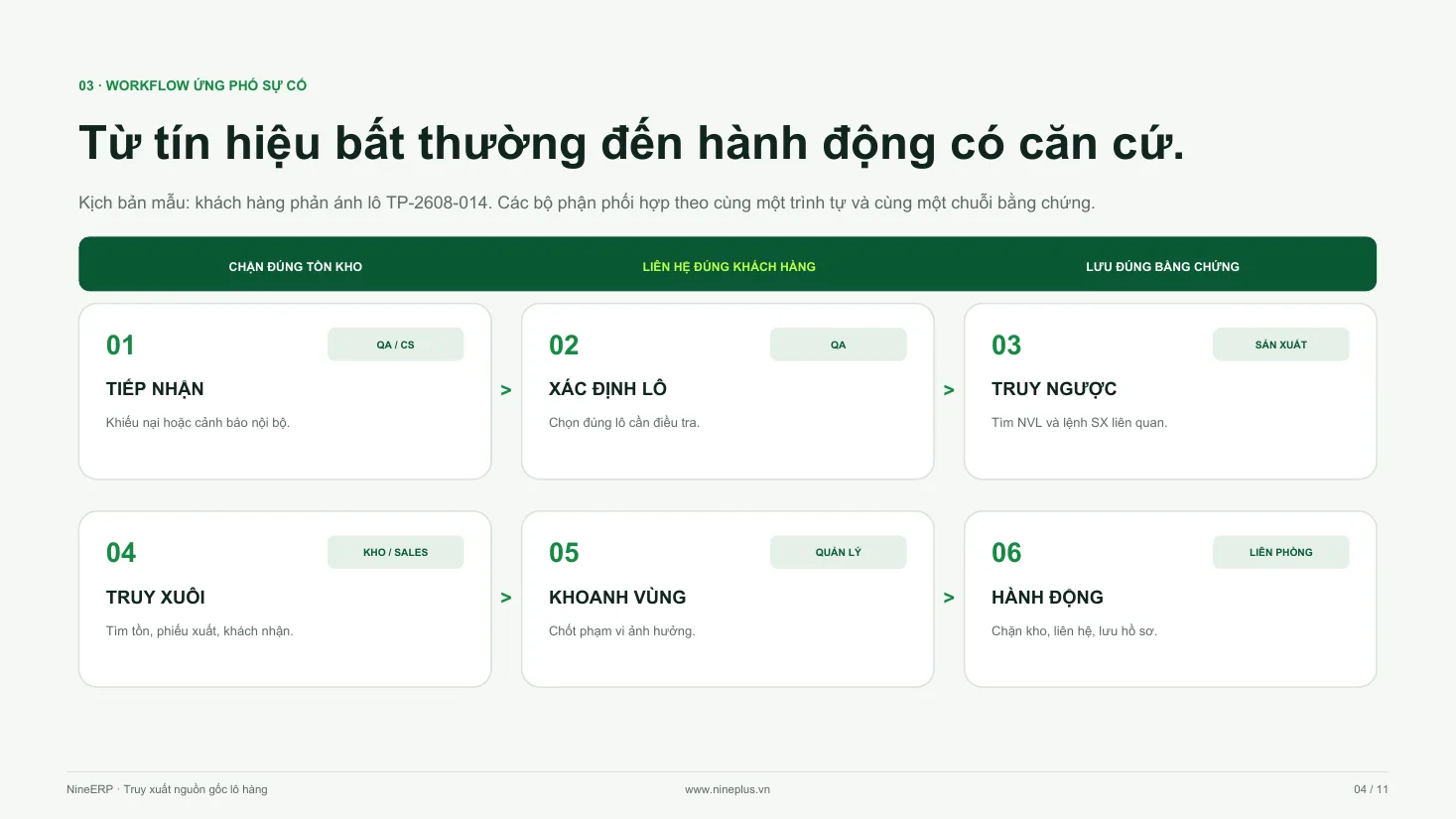
Once the data forms a chain, incident response can follow a clear sequence where each team knows its part:
- Receive (Customer service/QA): log the complaint or internal alert.
- Identify the lot (QA): pick the exact lot to investigate.
- Trace backward (Production): find the related materials and production orders.
- Trace forward (Warehouse/Sales): find stock, delivery notes and customers who received it.
- Contain (Management): confirm the scope of impact.
- Act (cross-team): hold stock, contact the right customers, keep the records.
Frequently asked questions
Does a small company need lot traceability?
If you sell food, chemicals, pharmaceuticals, cosmetics or anything with an expiry date, lot management is close to mandatory when working with larger partners. For goods without an expiry date, you can start with stock by warehouse and location and extend later.
We use Excel today — how do we move to a system?
The most important step is cleaning the product list, lot codes and opening stock before loading them. See Clean your data before the new system.
Do we need barcode scanners?
Not necessarily. Barcodes make entry faster and reduce errors, but tracing still works as long as lot numbers are recorded correctly on receipts, issues and production orders.
Further reading
- What ERP really is and when a company actually needs one
- The real cost of an ERP project
- Clean your data before the new system
How do you trace lots today?
If the answer is "open Excel and make some calls", your company is ready for the next step in operations management.
NINE PLUS SOLUTION,. JSC can demo backward and forward tracing on sample data, following your own business processes.
📞 Hotline: 0332.186877
🌐 Website: www.nineplus.vn — use the Contact page to book a demo.


